The Berea Record · Common questions
Most of what gets repeated about this competition is checkable. Here is each line with the number that answers it — and the ones the record cannot settle, marked as such.
Every response points at a figure in the charting or says plainly that the record does not settle it. Where a claim is fair, this page says it is fair. Practice statistics are one outlet's charting, independently corroborated. Not official statistics.
The method
Several of the most-repeated claims of this camp were never checked against the numbers they were built on. That is the whole reason this record exists.
Lines that travelled and do not hold
Each was said publicly and repeated. Each is checkable against the same charting everyone was already citing.
“I guess based on the tracker, Watson has been better.”
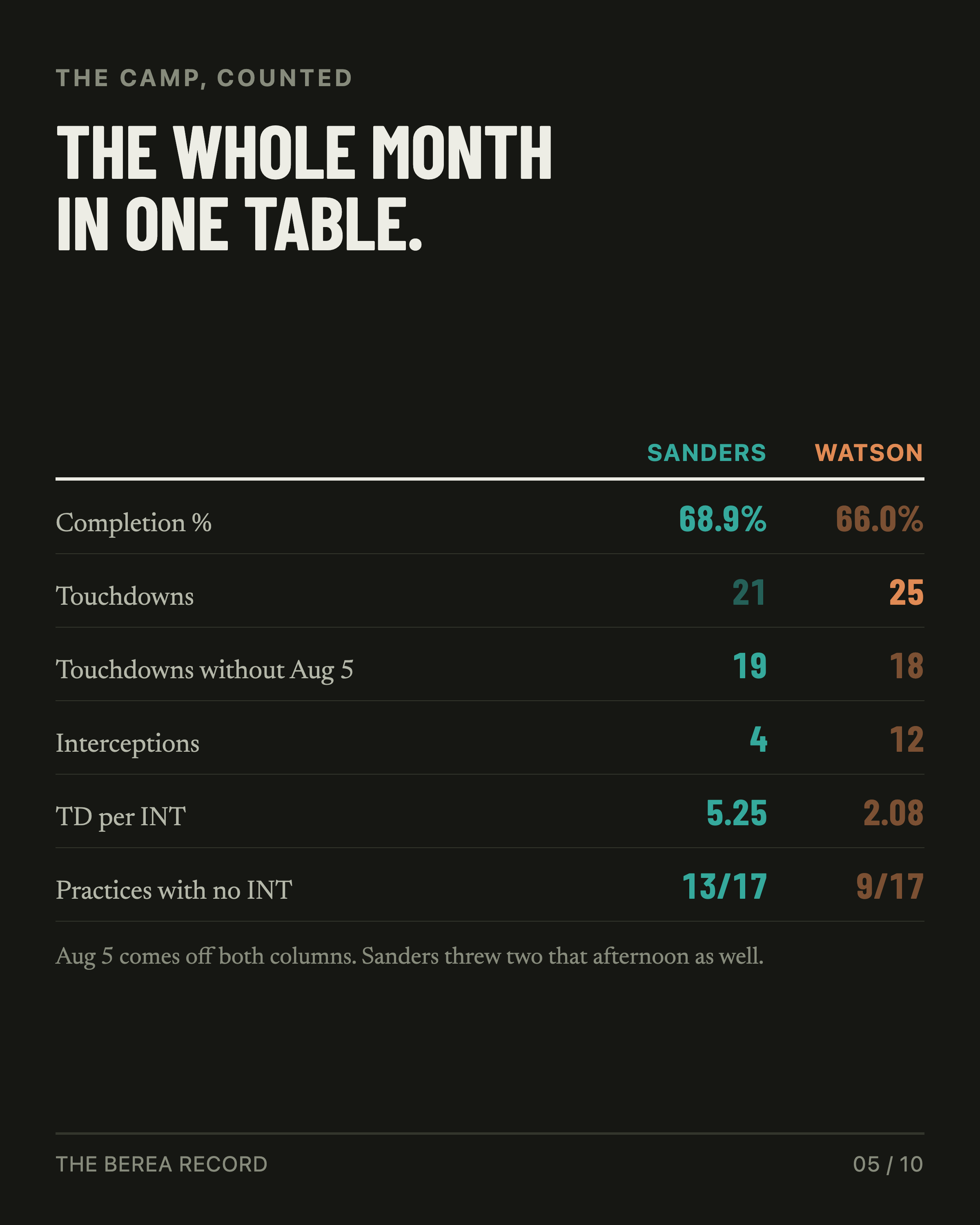
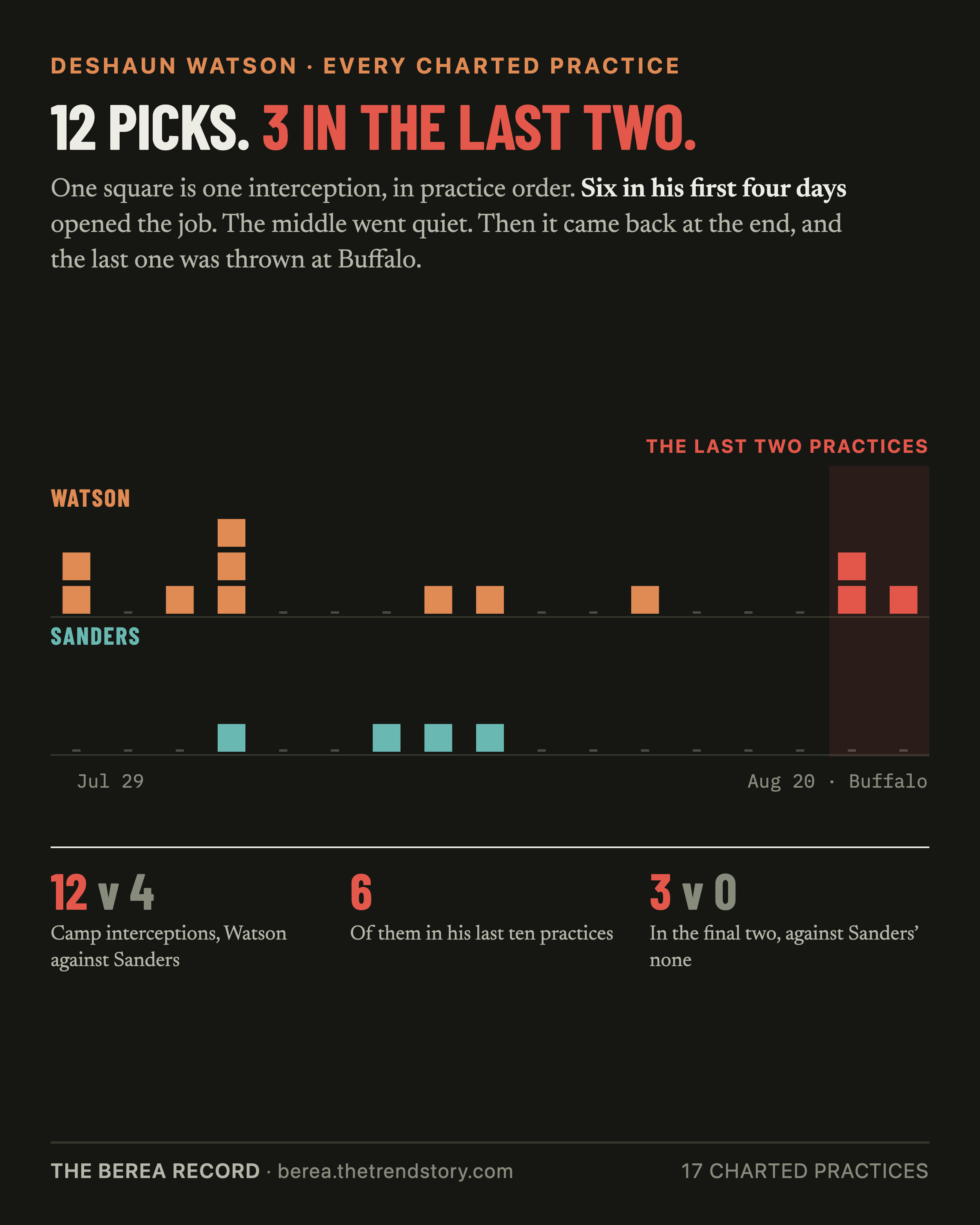
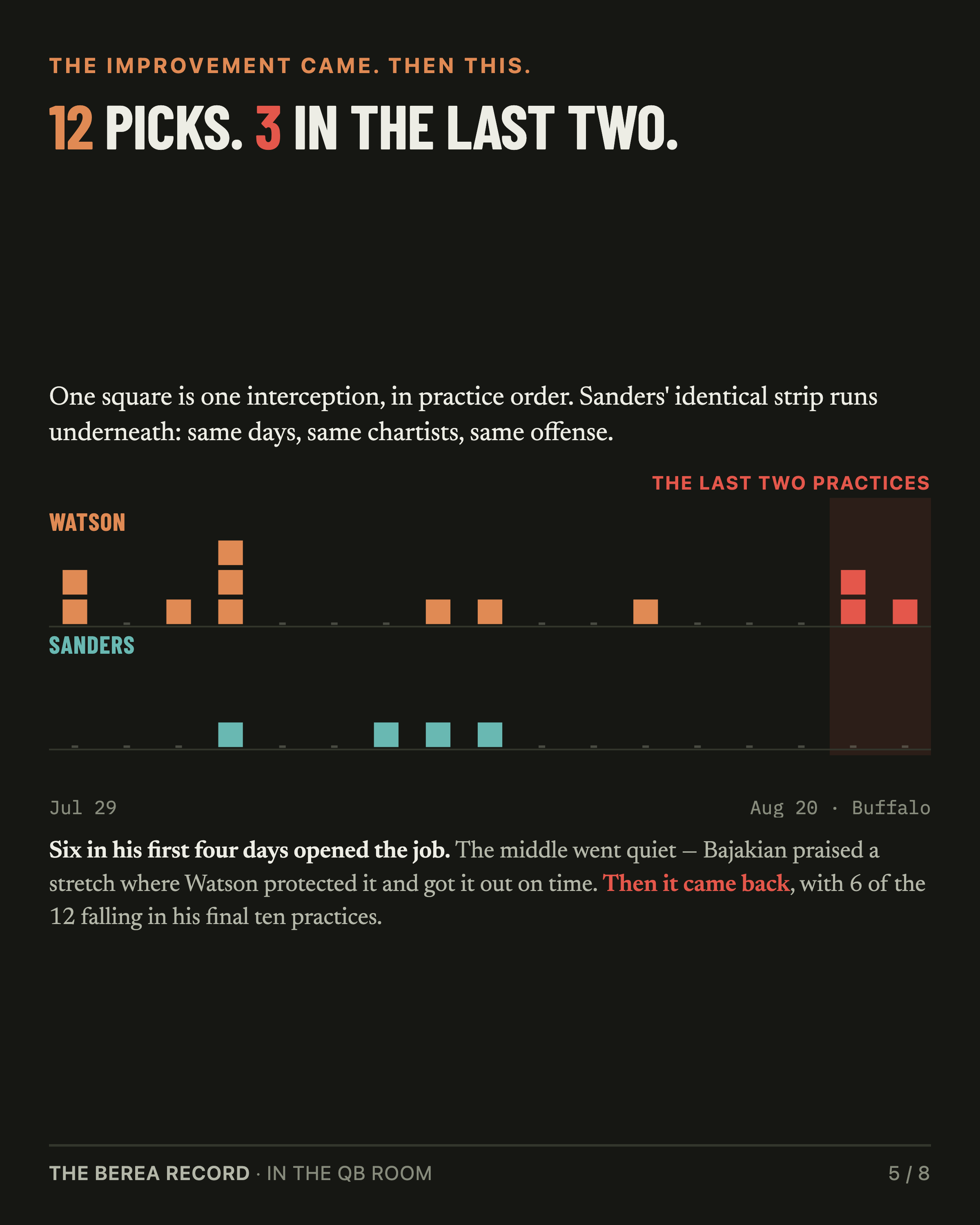
Across seventeen charted practices Sanders led completion percentage 68.9% to 66.0%, threw four interceptions to twelve, and finished at 5.25 touchdowns per interception against 2.08.
Watson led exactly one column, raw touchdowns, 25 to 21. Take August 5 off both sides and even that is 19 to 18.
“Since they increased his reps, he's had 13 TDs and 1 INT in 4 days.”
The charting for August 5–8 shows 13 touchdowns and two interceptions. Close, and the point survives, but it was repeated for a week without anyone checking it.
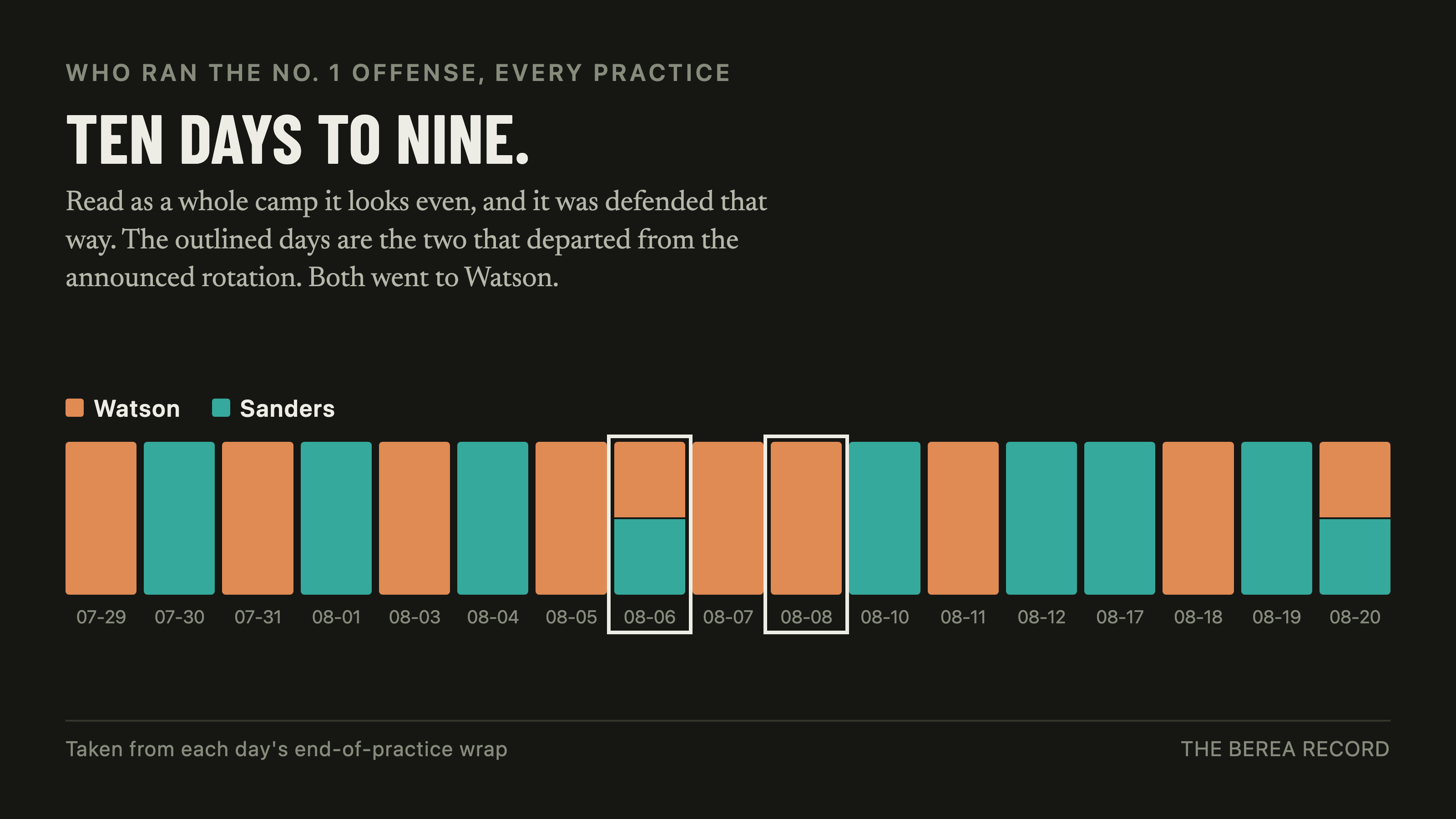
The larger problem is which four days they are. That stretch is the window where the announced rotation stopped applying, where Watson took 4.5 of 6 first-team days, and where his two biggest afternoons came without pads and without the starting cornerbacks.
“It's going to be Watson.”
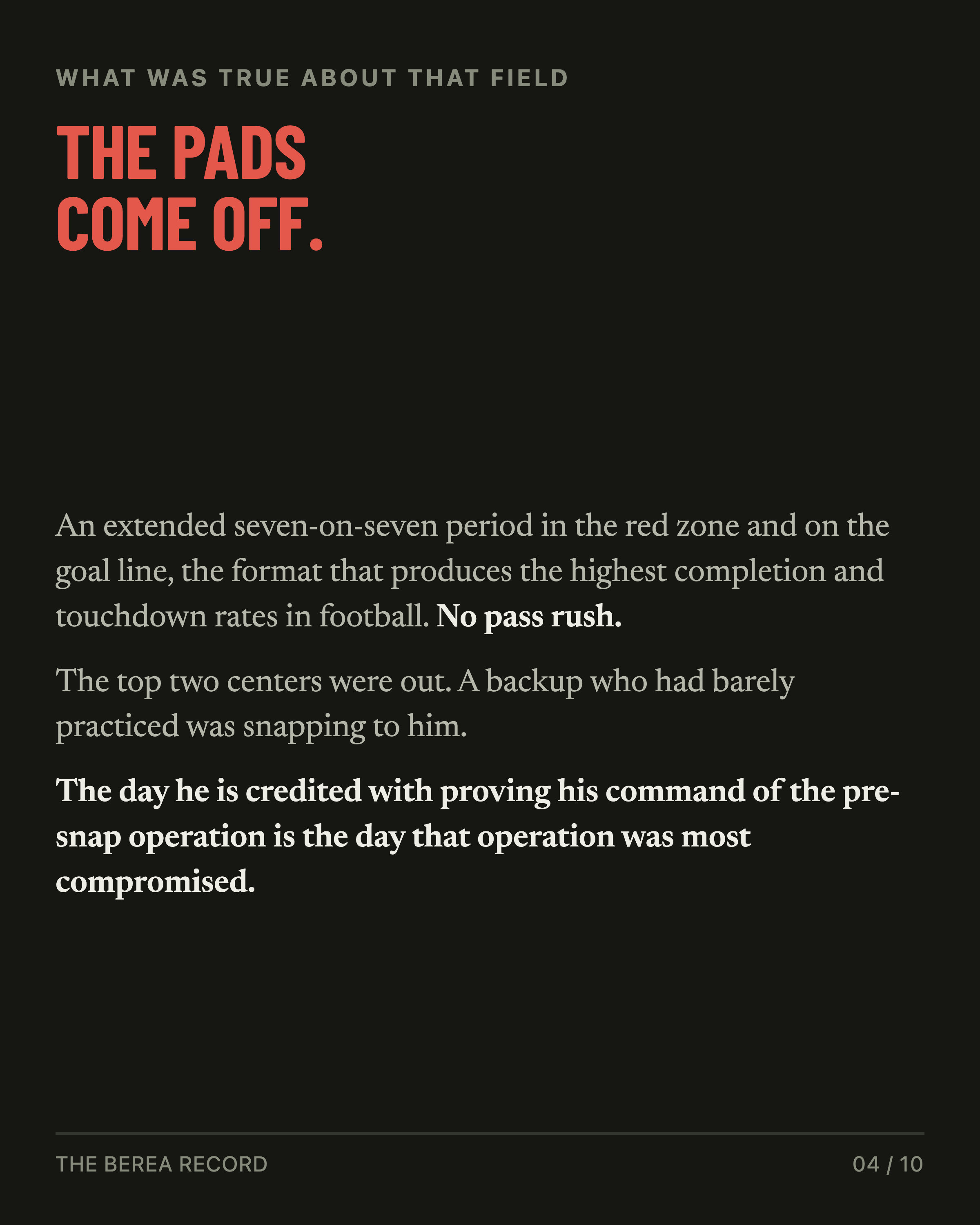
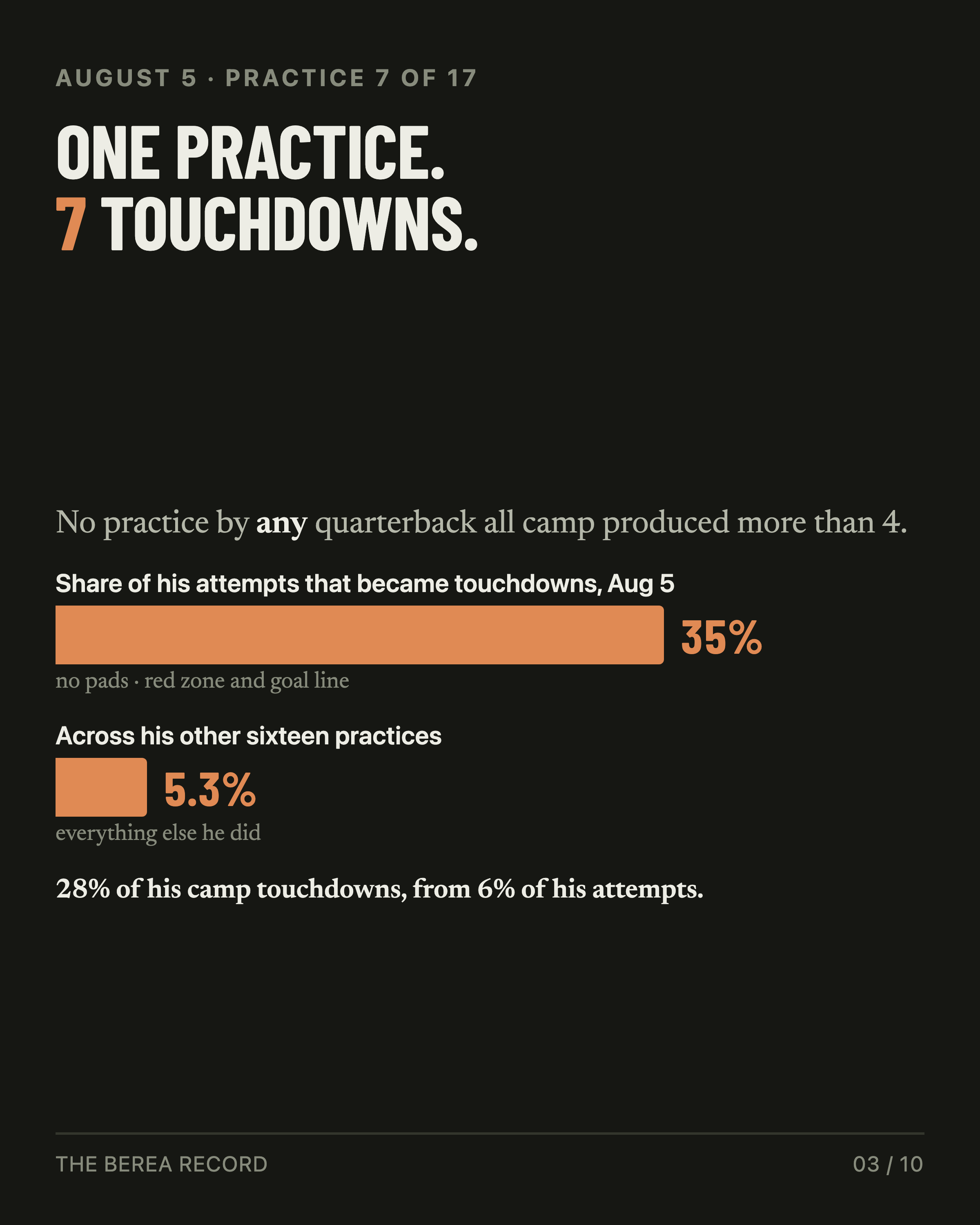
That went out on the evening of August 5. The practice it followed was an extended red-zone and goal-line seven-on-seven session with no pass rush, in which Watson threw seven touchdowns.
No practice by any quarterback all camp produced more than four. The number that settled the narrative was the least representative number of the month, and it travelled for two weeks without its conditions attached.
“There's no rhyme or reason to it. They're just alternating days and it worked out that way.”
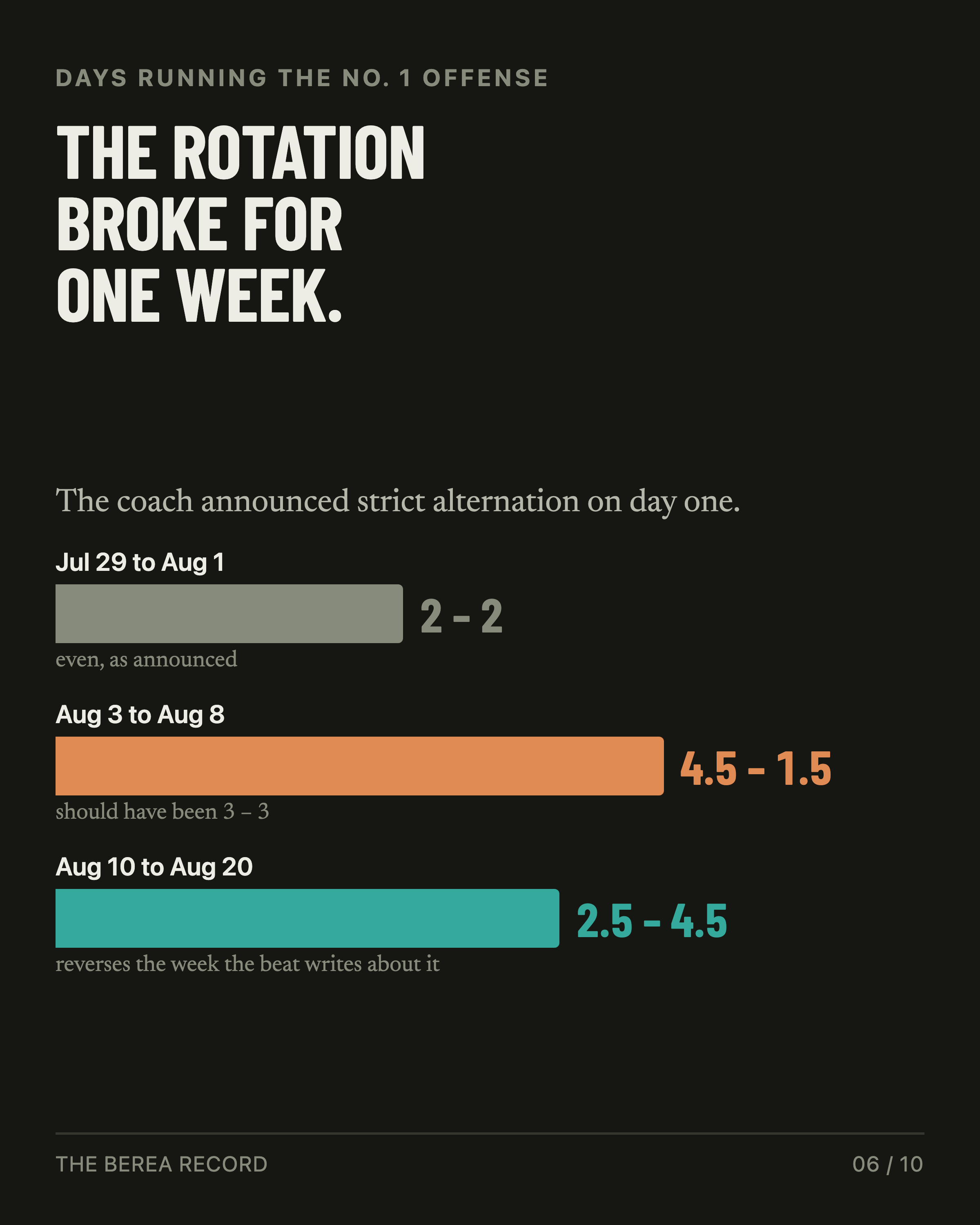
Strict alternation across August 3–8 would have been 3–3. It was 4.5–1.5. Before that stretch the split was even at 2–2; after the beat wrote about it, it reversed to 4.5–2.5 Sanders.
This is the narrowest version of the claim and the only one the record supports: the unevenness is concentrated in one week, not spread across the camp. Every day is taken from that day's end-of-practice wrap.
“In many cases the decision is made before the competition even begins. All that is needed is confirmation.”
It is quoted on the site because it is the argument the whole month actually ran on — and it never once touched the field. A claim that cannot be checked is not a stronger claim than one that can. It is a weaker one.
The record's answer is to show the rep ledger, the conditions and the results, and to label inference as inference wherever it appears.
Claims made about Sanders
The four that come up most. The first is now contradicted by his own position coach.
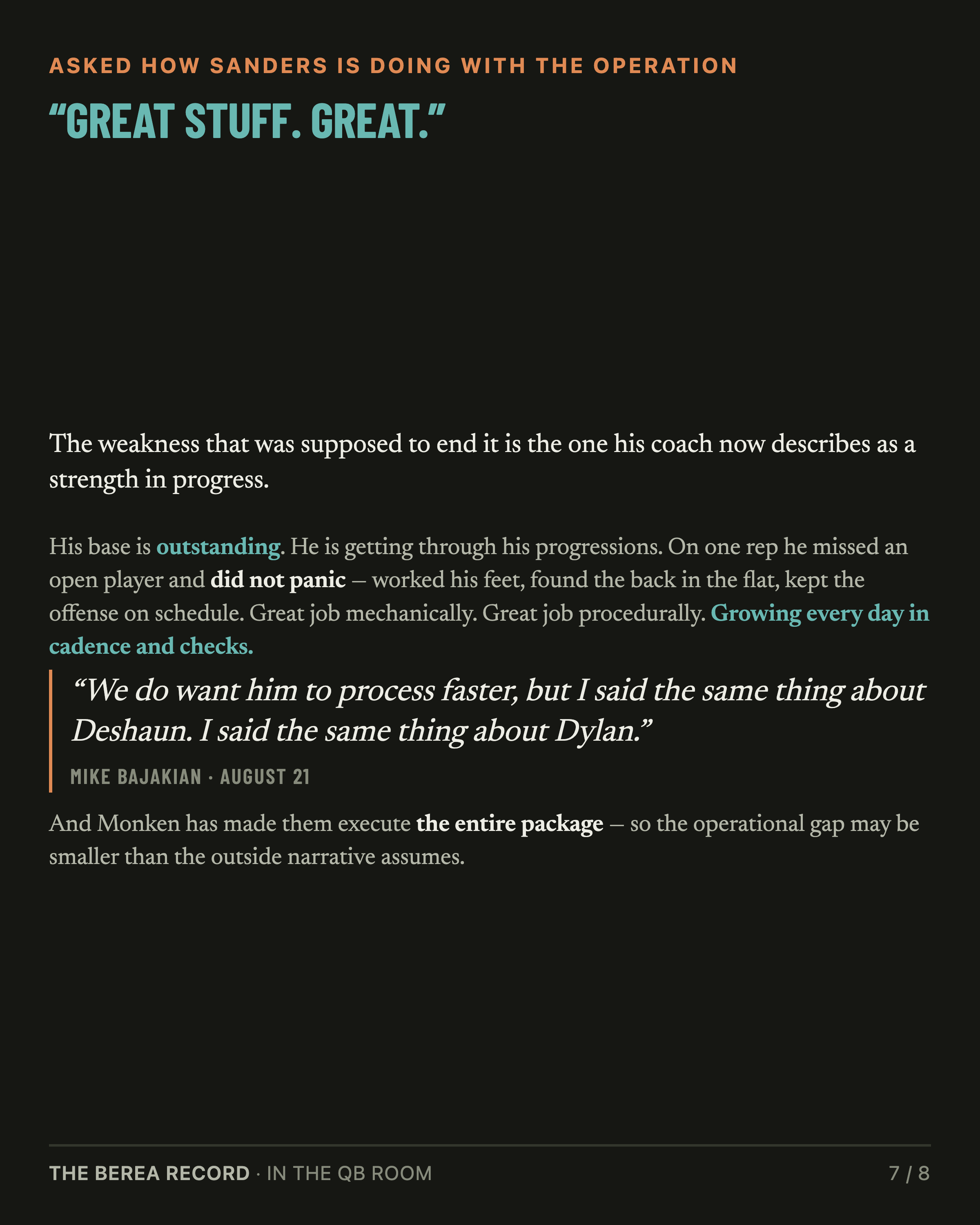
“He's talented, but he can't handle the operation.”
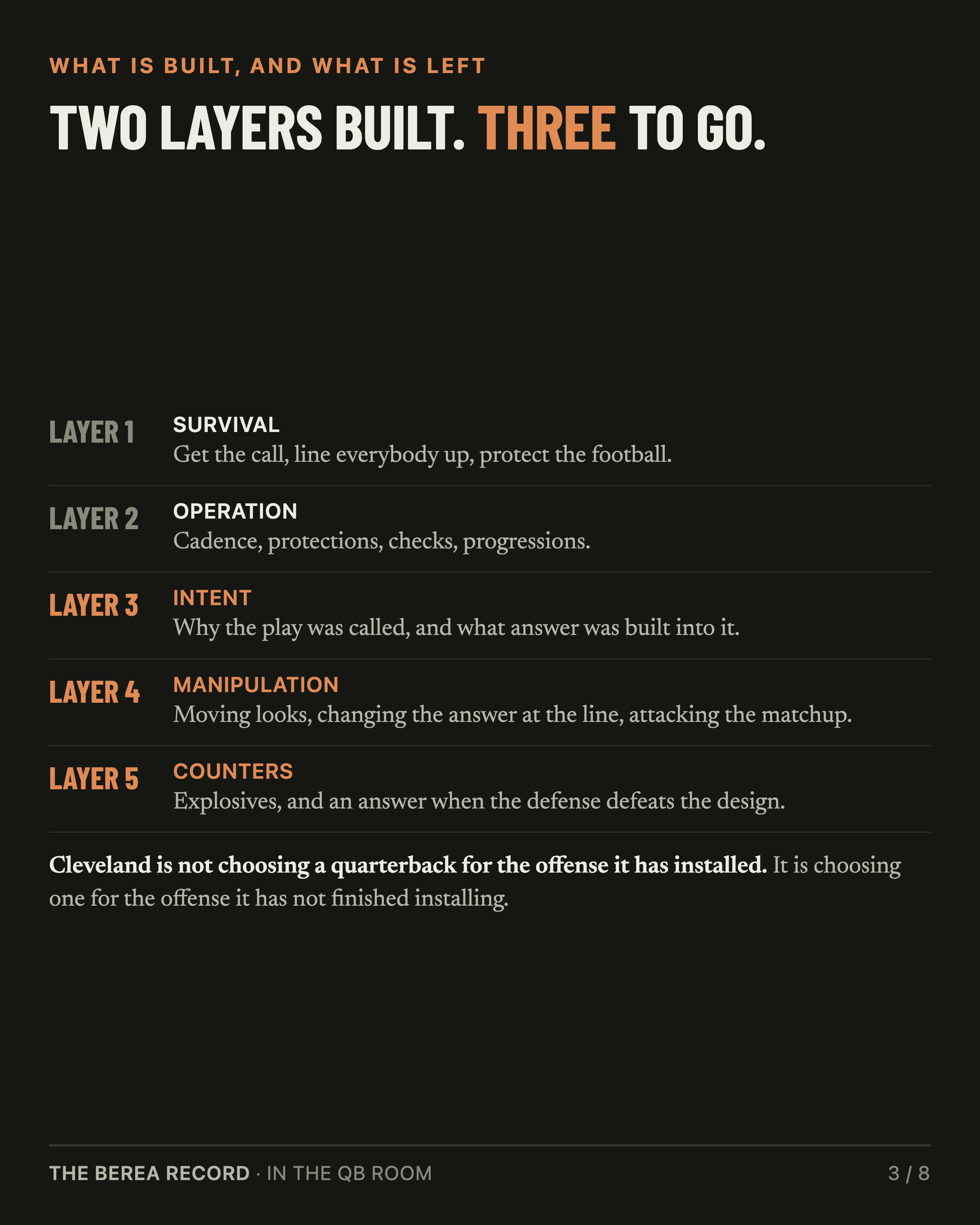
That was August 21. He went on: base outstanding, playing from a strong athletic platform, getting through his progressions, composed when the first read was not there — worked his feet, found the back in the flat, kept the offense on schedule. Great job mechanically. Great job procedurally. Growing every day in cadence and checks.
Asked whether Sanders specifically needs to process faster, he refused to make it unique to him: “We do want him to process faster, but I said the same thing about Deshaun. I said the same thing about Dylan.”
“He's only being protected by a simplified rookie game plan.”
Bajakian said Monken has deliberately thrown a lot at these quarterbacks through spring and camp and made them execute the entire package — checks, protections, full-field reads and explosives.
The operation is not being hidden for him. It is being demanded of him, which is a different claim entirely and a harder one to wave off.
“He was terrible against Chicago. A 39.6 rating.”
The rating is genuinely bad and the site says so. He went 6-of-11 for 79 with an interception.
The rest of that play-by-play: Watson averaged 4.4 air yards and completed nothing past ten yards downfield, attempting exactly one such throw. Sanders averaged 9.2 with two completions of twenty-plus, playing with and against backups. And Watson lost a strip-sack that Chicago recovered at the Cleveland 49 — both quarterbacks finished responsible for one lost turnover.
“He spiked the ball before the line was set. That's disqualifying.”
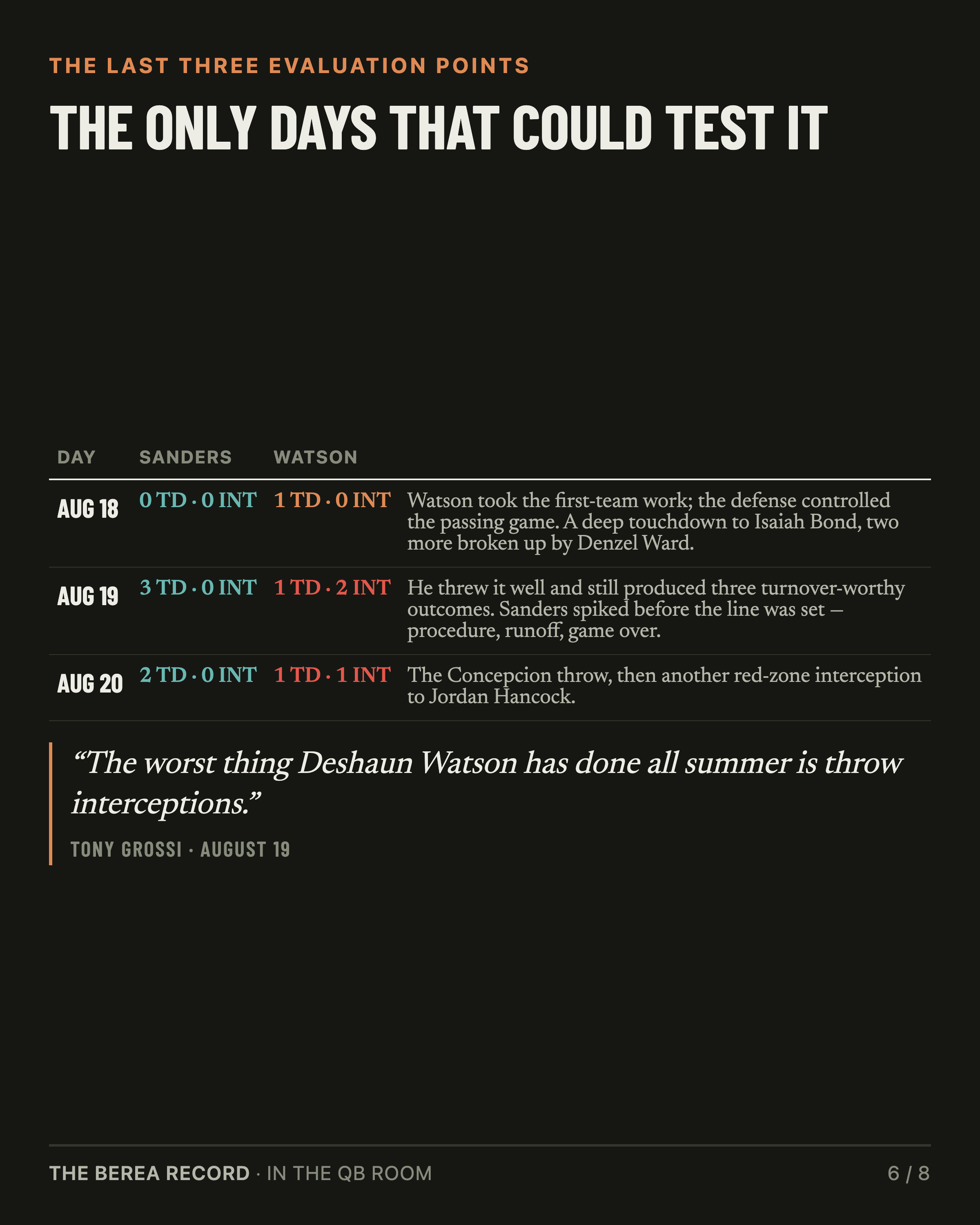
It cost the simulated game — illegal procedure, ten-second runoff, over. Monken hates exactly that. It is on the site rather than left out, because a record that hides its counter-evidence is not a record.
Two things sit beside it. On that same afternoon Sanders threw three touchdowns and no interceptions. And the error has an obvious correction — here is the mistake, here is the rule — where a recurring turnover problem is the harder question, because Cleveland had already spent the month trying to fix it.
Claims made about Watson
Where his case is real, this page says so. The argument is narrower than the noise on either side.
“Watson has clearly been the better quarterback in camp.”
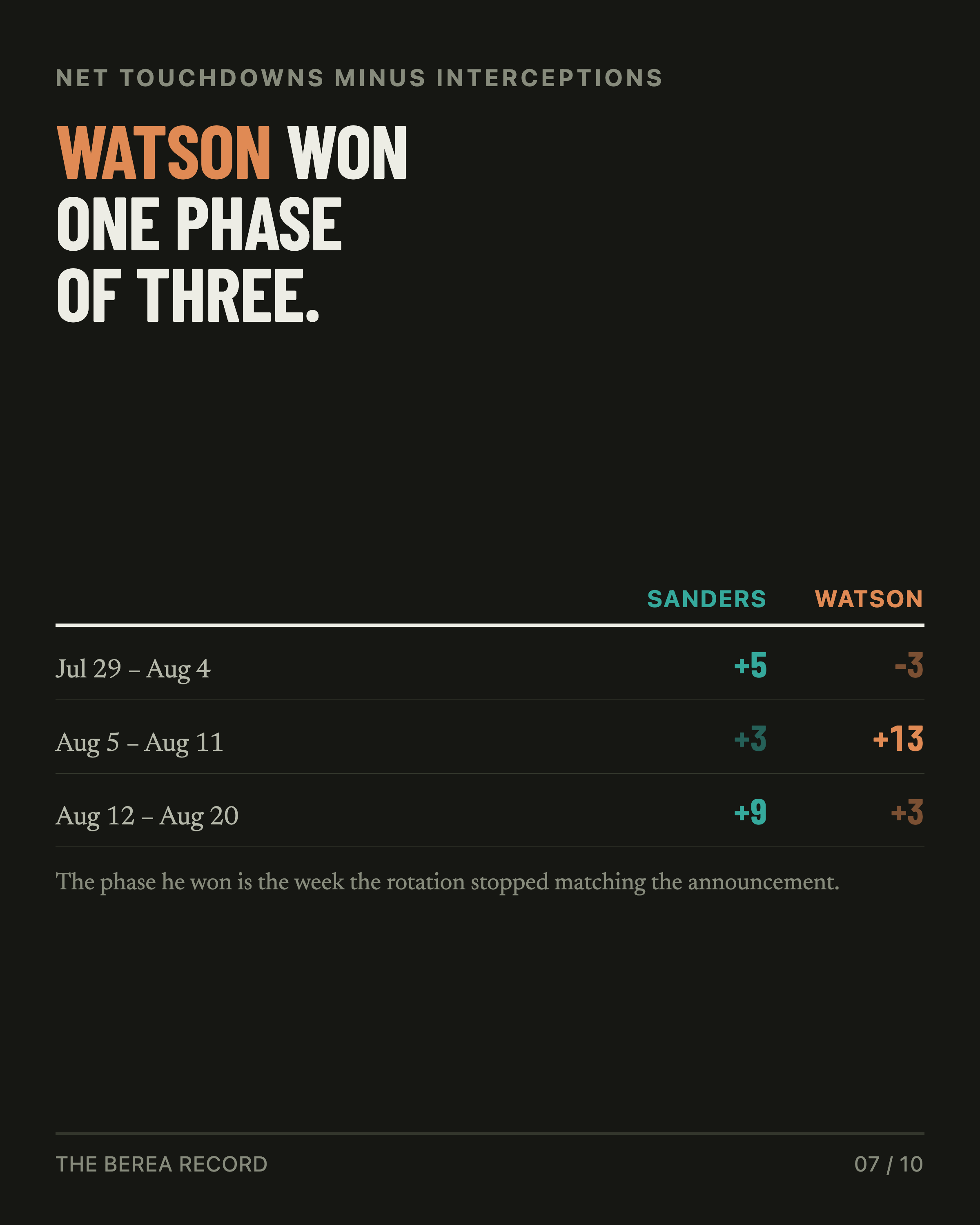
Split the camp into three blocks and net touchdowns against interceptions: Sanders wins the opening block +5 to −3, Watson wins the middle +13 to +3, Sanders wins the close +9 to +3.
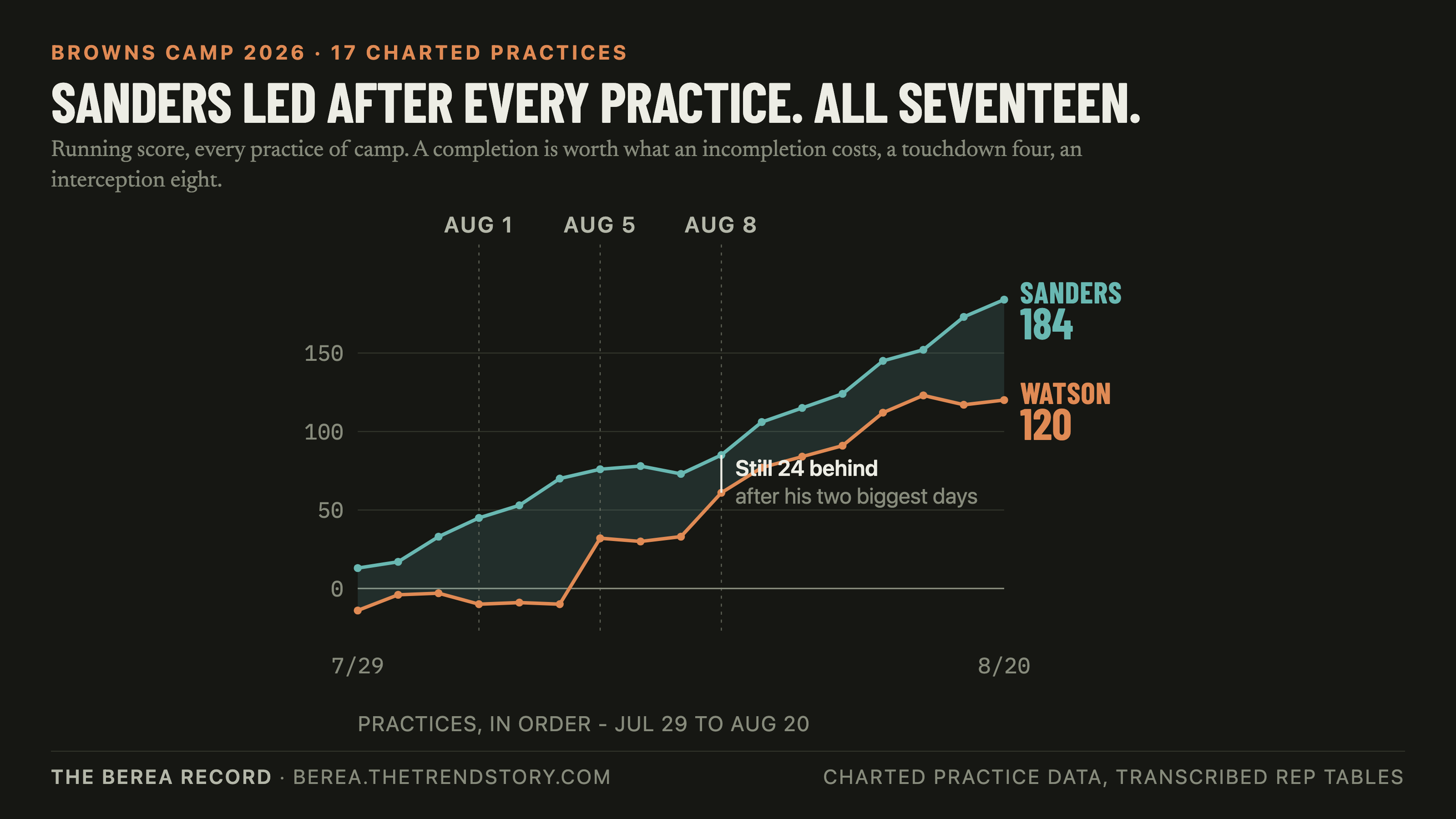
The one block Watson won is the week the rotation stopped matching the announcement. Scored cumulatively across all seventeen practices, Sanders led after every single one and was never once behind.
“The veteran obviously runs the offense better.”
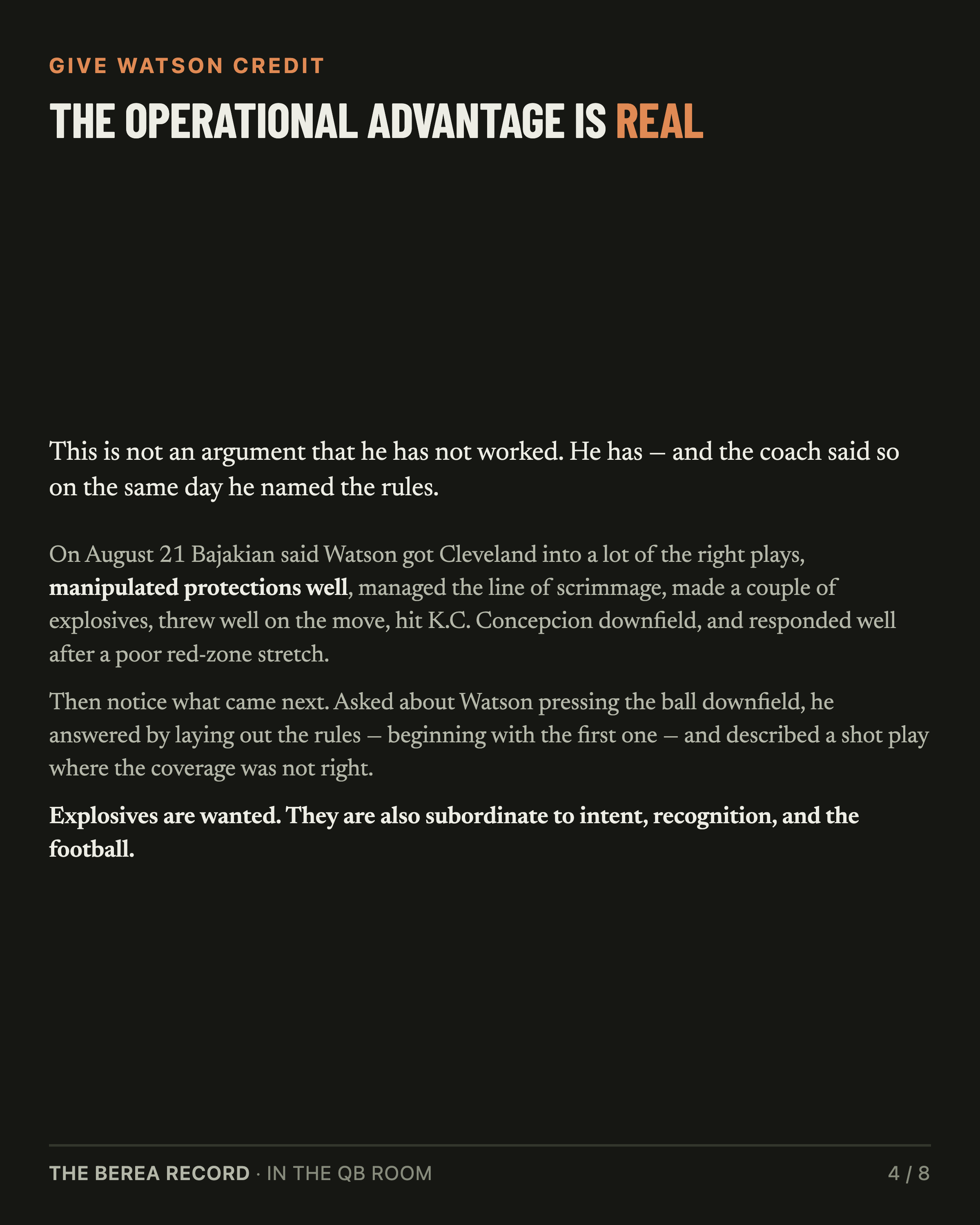
On August 21 Bajakian said Watson got Cleveland into a lot of the right plays, manipulated protections well, managed the line of scrimmage, made a couple of explosives and threw well on the move. That advantage is real and this record does not dispute it.
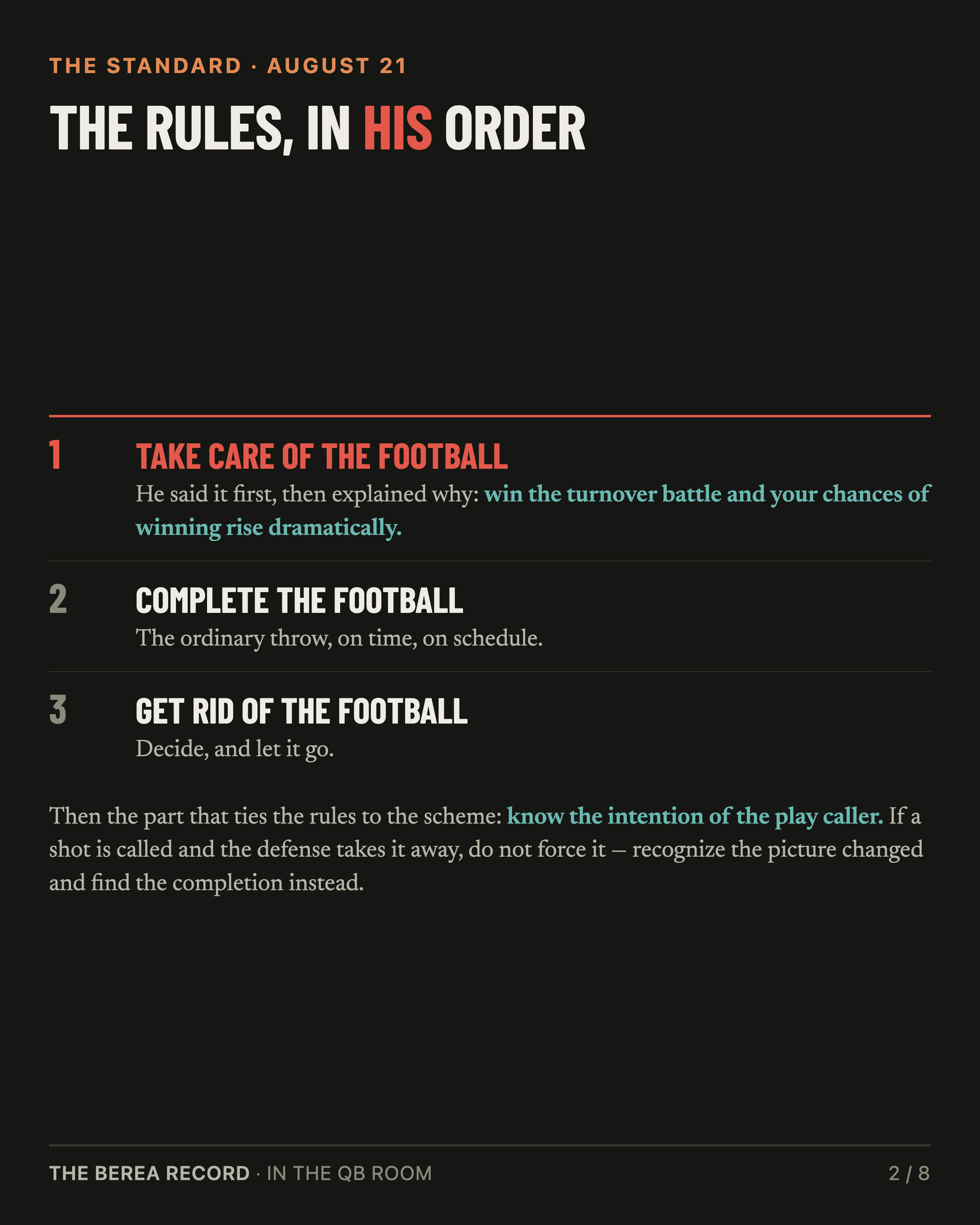
The argument is narrower: the staff's stated first rule is take care of the football, and that is the thing that has recently gone wrong again — six of his twelve interceptions in his final ten practices, three in the last two days.
“One bad practice doesn't mean anything.”
The claim is not volume. It is recurrence after apparent correction — the interceptions clustered early, went quiet through the middle while the staff worked on it, and then came back at the end.
Challenges to this record itself
“You're just throwing out his best day. That's cherry-picking.”
Sanders threw two touchdowns that afternoon as well. Remove August 5 from both and it is 19 to 18 — not 21 to 18, which was wrong and has been corrected everywhere on the site.
The point is not that the touchdowns did not happen. It is that one practice produced 28% of Watson's camp scoring from 6% of his attempts, in the softest conditions of the month.
“Your composite score is a made-up metric.”
Sanders finishes ahead under every ordinary weighting. The two only tie if a touchdown is worth four times what an interception costs, and Watson only leads once a touchdown is worth thirteen against an interception's four.
The weights were fixed before the series was plotted and cannot be changed from outside the module, because a metric you can dial is not evidence.
“These aren't real statistics.”
The NFL does not publish practice numbers. These come from one outlet's published rep tables, transcribed and independently checked: a separate tracker publishing cumulative totals agrees on sixteen of sixteen values through August 11.
Every figure on every page is computed from that file at build time. Nothing is typed into a page by hand, which is what stops a chart drifting from its source.
“Why should anyone trust a site nobody has heard of?”
Every number traces to a published rep table or a named reporter's post, the corpus is dated and attributed, and where the record is thin the page says so.
Two corrections have already been made in public: a touchdown total that subtracted August 5 from one column only, and a preseason yardage figure printed two different ways. An account that shows its corrections is easier to check than one that has none.
What this record will not claim
Overclaiming is how a checkable argument gets dismissed. These are the lines not to cross when citing it.
Nothing said publicly by anyone describes a meeting, a conversation or an instruction. That step is inference and it is labeled as inference. The reporter closest to the building gave a football reason on the record — the Browns were perplexed by Watson's interceptions and decided to give him more reps. That is a defensible coaching decision and it is not a scandal.
He threw them and the receivers caught them, and a quarterback in a slump needed a day like that. What is true is narrower: it came from the least representative practice of the month and was quoted for two weeks without its conditions.
Nobody has produced evidence that Haslam or Berry told Monken to start Watson, and none is alleged. Three first-round picks and $230 million guaranteed is weight that does not require an instruction to be felt — that is the whole claim, and it stops there.
No starter had been named as of August 20. The reconstruction stops at the last charted practice, and the two argument pages say plainly that they are arguments.
Six incidents to four across seventeen practices is what reporters happened to mention, and it undercounts everything unevenly. Its only value is that both quarterbacks were watched by the same people on the same days. Lead with the direction, never the size. One clarification, because it is easy to get wrong: that count is incidents, not reports — three writers describing the same drill is one incident.